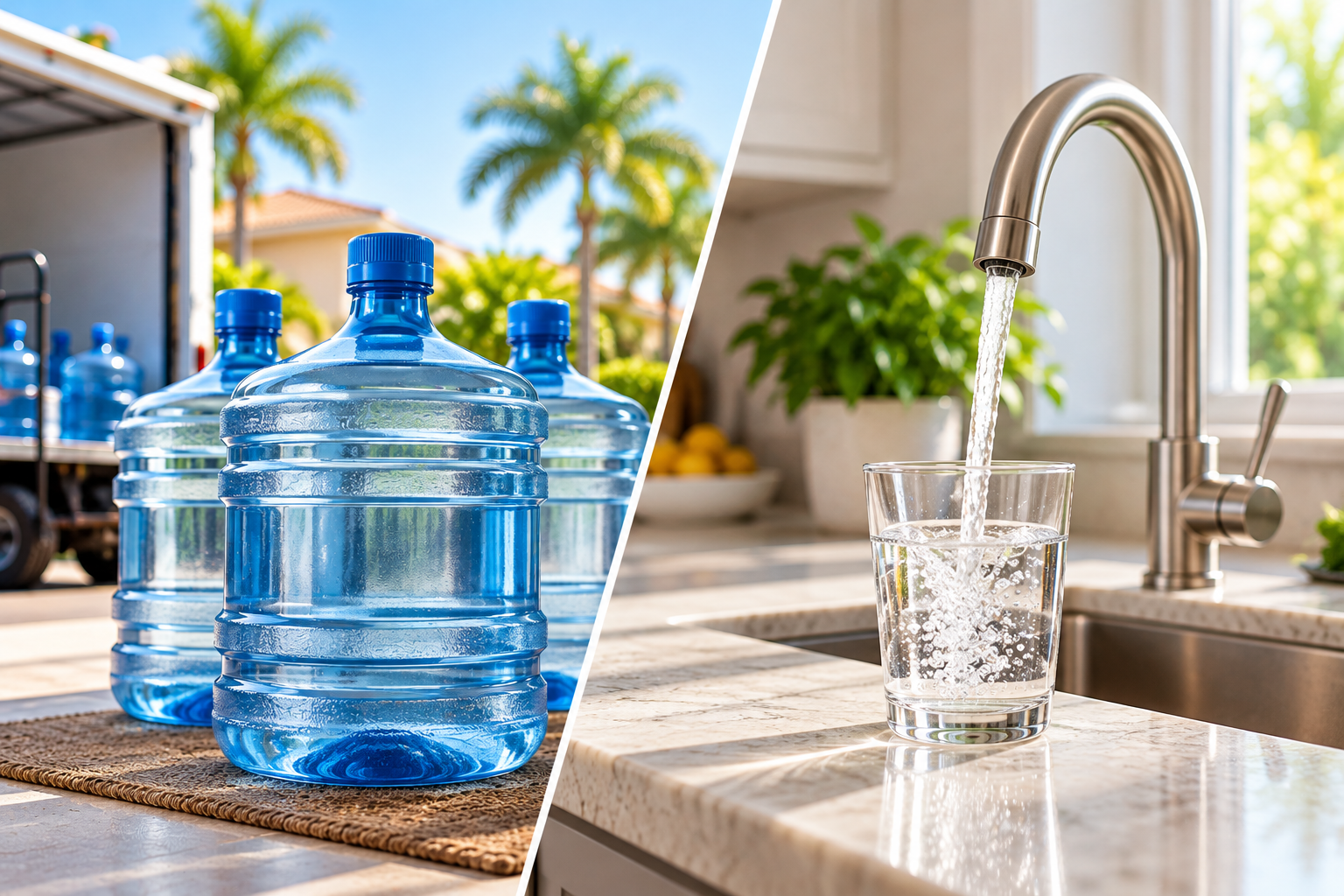
Key Takeaway: Water contaminants include a wide range of substances—some regulated, some unregulated, and many invisible—that can affect taste, odor, buildup, and confidence in your home’s water. While Tampa Bay’s water meets federal standards, household plumbing, local conditions, and emerging contaminants mean many homeowners take an extra step with testing and water treatment systems to achieve cleaner, better-performing water.
If you’ve ever noticed a chlorine taste, stubborn spots on dishes, scale buildup around fixtures, or dry skin after showering, you’re not alone. Many homeowners across Tampa Bay ask the same question: what’s actually in my water?
Public drinking water is treated to meet federal and state standards, but that doesn’t mean every home experiences water in the same way. Source water, treatment methods, aging infrastructure, and household plumbing can all influence what reaches your tap. Understanding water contaminants—and how they’re regulated—helps homeowners make informed decisions about water filtration and water treatment systems that fit their needs.
What is considered a water contaminant?
A water contaminant is any physical, chemical, biological, or radiological substance that may be present in water and affect health, taste, odor, or performance. The Environmental Protection Agency (EPA) categorizes drinking water contaminants into groups such as microbial organisms, inorganic and organic chemicals, radioactive elements, and disinfectants or their byproducts. The EPA provides a detailed overview of these categories in its explanation of types of drinking water contaminants.
Not all contaminants are immediately harmful, and many are present at levels considered acceptable under federal guidelines. However, even low levels of certain substances can influence how water tastes, smells, or behaves in your home. Minerals can leave scale, disinfectants can affect flavor, and emerging contaminants may raise longer-term questions even when water meets compliance standards.
How does the EPA regulate drinking water contaminants?
The U.S. Environmental Protection Agency (EPA) regulates public drinking water under the Safe Drinking Water Act by setting enforceable standards for more than 90 contaminants. These rules define maximum allowable levels, required treatment techniques, and monitoring schedules that public water systems must follow to remain in compliance. A complete list of these standards is maintained in the EPA’s Drinking Water Regulations.
These regulations are designed to protect public health across entire communities, often serving hundreds of thousands—or millions—of people from a single system. To accomplish this at scale, the EPA evaluates scientific health data alongside practical considerations, such as whether treatment technologies are widely available, reliable for continuous use, and financially feasible for municipalities to implement system-wide.
This balance between health protection and real-world implementation is outlined in the EPA’s National Primary Drinking Water Regulations framework, which explains that regulatory limits are set using both health-based goals and enforceable standards shaped by technical and economic feasibility. That framework is detailed in the EPA’s official guidance document, National Primary Drinking Water Regulations Reference Guide.
Important context: EPA drinking water standards are not based on health considerations alone. They are also influenced by treatment technology availability, operational reliability, and affordability for public water systems serving large populations.
This approach ensures water is legally safe for public consumption, but it also explains why regulatory limits may not represent the lowest detectable level or the most conservative possible threshold for every contaminant. In other words, compliance means a system meets federal requirements—not that all substances have been reduced as far as current technology allows.
Why are some contaminants unregulated but still monitored?
In addition to regulated contaminants, the EPA monitors many substances through the Unregulated Contaminant Monitoring Rule (UCMR). UCMR requires certain public water systems to test for emerging contaminants so scientists and regulators can better understand how often they occur, where they appear, and at what concentrations. More details about this program are available in the EPA’s overview of the Unregulated Contaminant Monitoring Rule.
Monitoring does not mean a contaminant is known to be harmful, nor does it mean utilities are required to remove it. Instead, UCMR data helps inform future research, risk assessments, and potential regulatory decisions. This is why some substances may appear in water quality reports even though no enforceable federal limit currently exists.
For homeowners, this distinction is important. A contaminant can be present at detectable levels, tracked by regulators, and still fall outside enforceable treatment requirements for municipal systems.
Why this matters at home: Public water systems are designed for population-wide compliance. Household filtration allows homeowners to act as the final line of refinement—addressing taste, performance, and unregulated or emerging contaminants based on their own comfort level and preferences.
Quick Facts: Water Contaminants at a Glance
- The EPA regulates more than 90 contaminants in public drinking water.
- Many additional contaminants are unregulated but monitored through programs like UCMR.
- Regulatory limits balance health protection with feasibility and cost for public utilities.
- Home water testing helps identify which issues matter most at your tap.
What types of water contaminants affect homes most often?
Water contamination isn’t a single issue—it’s a profile. Most homeowner concerns fall into a few broad categories, each affecting water in different ways. Understanding these categories makes it much easier to choose the right water filtration or water treatment system instead of guessing.
Chemical contaminants
Chemical contaminants include substances added during treatment as well as compounds that enter source water through industrial activity, consumer products, or environmental runoff. In municipal systems, disinfectants such as chlorine play an important role in protecting public health, but they can also affect taste and odor. Other chemical concerns may include disinfection byproducts and compounds that persist in the environment.
Many homeowners notice chemical-related issues as a strong chlorine taste, a swimming-pool smell, or water that feels harsh. These effects don’t always indicate unsafe water, but they do influence how enjoyable water is to drink and use throughout the home.
Biological contaminants such as bacteria
Biological contaminants include bacteria, microorganisms, and other living organisms that can enter water through groundwater intrusion, plumbing issues, or environmental exposure. In Florida’s warm, humid climate, bacterial growth can be more common—especially in private wells, older plumbing systems, or after heavy rainfall and flooding events.
Bacteria are typically not visible and may not affect taste or odor, which is why testing is so important. Homeowners concerned about bacteria in household water often look to targeted filtration or disinfection systems designed to address biological contaminants at the point of entry or use.
Inorganic and naturally occurring contaminants
Some contaminants originate naturally from soil and rock as water moves through the environment. Metals such as iron or trace elements like arsenic can enter groundwater depending on local geology. At certain levels, these substances may cause staining, discoloration, or changes in taste. Others are regulated because of potential long-term health concerns.
Because many of these contaminants are invisible and odorless, they often go unnoticed without testing. This is one reason homeowners sometimes feel confused when water “looks fine” but still causes buildup, staining, or concern.
Physical contaminants and sediment
Physical contaminants include sediment, sand, and fine particles that may enter water from source conditions or aging infrastructure. These materials can cloud water, clog fixtures, and reduce the effectiveness of appliances and filters.
While sediment is not typically a health issue at low levels, it can accelerate wear on plumbing and water-using appliances. Many homeowners first notice sediment when aerators clog or water pressure drops unexpectedly.
Minerals, hardness, and performance-related issues
Hardness minerals—primarily calcium and magnesium—are extremely common in Florida water. These minerals are not considered harmful, but they can significantly affect how water behaves in the home. Scale buildup, soap that doesn’t lather well, cloudy glassware, and stiff laundry are all classic signs of hard water.
Because hardness affects performance rather than safety, it often isn’t top of mind until homeowners experience repeated maintenance issues or appliance inefficiency. For many Tampa homeowners, understanding the costs and benefits of a water softener system helps clarify whether treatment makes sense for their home and long-term maintenance goals.
Fluoride and naturally occurring trace elements
Fluoride is another naturally occurring element found in groundwater throughout parts of Florida. Even after Florida’s 2025 law prohibiting the addition of fluoride to public drinking water, naturally occurring fluoride can still be present in the Tampa Bay area’s water supply. The law restricts intentional fluoridation but does not require utilities to remove fluoride that occurs naturally.
For some homeowners, fluoride is not a concern. Others prefer to reduce it based on personal or household preferences, particularly for drinking and cooking water. In these cases, point-of-use filtration systems are often used to provide additional control over what remains in finished water.
Emerging and unregulated contaminants
Emerging contaminants are substances that are increasingly detected and studied and may be regulated before treatment requirements are fully enforceable. PFAS are one of the most well-known examples. The EPA has finalized new national drinking water standards for certain PFAS compounds due to their documented health and environmental risks, but implementation and enforcement timelines are still being phased in.
In the meantime, PFAS and other emerging contaminants continue to be monitored through programs like UCMR to help scientists and regulators understand how often they appear and at what concentrations. Their presence does not automatically mean water is unsafe, but it does explain why some homeowners choose additional filtration as a precaution or for added peace of mind.
Key idea: Different contaminants require different treatment approaches. A system designed to improve taste may not address bacteria, hardness, or fluoride, and a softener won’t reduce chemical compounds. Matching the solution to the category matters.
What do Tampa-area water reports tell homeowners?
In the Tampa Bay region, public water suppliers publish annual Consumer Confidence Reports (CCRs) that summarize what is tested for, what is detected, and whether the system complies with federal drinking water regulations. Tampa’s most recent Water Quality Report shows compliance with EPA standards while documenting substances commonly found in treated surface water, including disinfectants, disinfection byproducts, and naturally occurring minerals.
Alongside these official reports, independent analyses such as the Environmental Working Group’s review of Tampa’s water system provide a different lens. Unlike the EPA, which sets enforceable limits by balancing health data with treatment feasibility and cost for large public systems, EWG evaluates water quality using health-based guidelines alone. Their analysis focuses exclusively on potential long-term health risk, without accounting for what is currently practical or affordable for municipal systems to control at scale.
Because of this difference in approach, EWG benchmarks are often far more conservative than EPA regulatory limits. Substances like arsenic that appear well below legal thresholds in a CCR may still exceed EWG’s health-based recommendations. This does not necessarily mean a utility is out of compliance or that water is unsafe, but it does highlight areas where some homeowners may want greater control over their finished water.
Tampa also participates in nationwide monitoring under the Unregulated Contaminant Monitoring Rule (UCMR), which tracks emerging substances that may not yet have enforceable federal limits. UCMR data helps regulators study frequency and concentration trends over time, but it does not require utilities to remove these contaminants unless and until standards are finalized and enforceable.
It’s important to understand what all of this data represents. CCRs, EWG summaries, and UCMR results reflect averages across a large service area and are designed to evaluate system-wide performance. They do not account for what happens inside individual homes, where plumbing materials, water heaters, fixture buildup, and usage patterns can change water characteristics before it reaches your tap.
Why water can meet standards and still feel “off” at the tap
Many homeowners are surprised to learn that water can fully comply with federal standards and still cause everyday frustrations. Compliance focuses on population-wide safety, not necessarily on taste, scaling, or appliance performance. As water travels from the treatment plant to your home, it can pick up minerals, lose disinfectant strength, or interact with plumbing materials.
This gap between compliance and experience explains why two neighbors served by the same utility may have very different opinions of their water. It also explains why household-level testing is often the missing step—and why some homeowners explore point-of-use options like reverse osmosis systems for drinking and cooking water when taste or confidence is the primary concern.
How homeowners can interpret contaminant information more confidently
When reviewing water quality information, it helps to ask a few practical questions:
- Is this substance regulated, monitored, or both?
- Does it primarily affect health, or does it affect taste, odor, or performance?
- Is it likely coming from the source water, treatment process, or home plumbing?
Answering these questions puts contaminant data into context and prevents overreaction or unnecessary treatment. It also makes conversations with water professionals more productive, because recommendations can be tied directly to specific concerns instead of assumptions.
Want clarity about your water? Testing is the most direct way to translate water quality reports and contaminant categories into actionable decisions for your home. Once you know which issues matter most at your tap, choosing the right filtration or treatment system becomes far more straightforward.
Learn more about professional water testing in the Tampa area
How water treatment systems address different contaminant categories
Once testing identifies which contaminants matter most in your home, the next step is choosing a treatment approach that directly addresses those issues. There is no single system that solves every water problem, which is why understanding how different technologies work is so important.
Whole-home water filtration
Whole-home filtration systems treat water at the point where it enters the house. These systems are commonly used to improve taste and odor, reduce chlorine, capture sediment, and create more consistent water quality throughout the home. Because they treat all water before it reaches faucets, showers, and appliances, they are often chosen when performance and comfort are the primary goals.
Homeowners exploring this option often start by learning how a whole house water filter works and which contaminants it is designed to address.
Reverse osmosis for drinking and cooking water
Reverse osmosis systems are typically installed at a single point of use, such as the kitchen sink. These systems are designed to reduce a wide range of dissolved substances and are commonly chosen for improving drinking and cooking water quality.
Because reverse osmosis focuses on water used for consumption, many homeowners pair it with a whole-home system for broader protection. To better understand this option, you can explore how reverse osmosis systems work and when they are most effective.
Water softening for hardness-related issues
Water softeners are designed specifically to address hardness minerals like calcium and magnesium. While these minerals are not considered health risks, they are a leading cause of scale buildup, appliance inefficiency, and cleaning frustration in Florida homes.
A softener does not filter contaminants in the traditional sense. Instead, it prevents scale from forming by changing how hardness minerals behave in water. Homeowners dealing with spotting, buildup, or reduced appliance lifespan often find relief through a properly sized water softening system.
Targeted solutions for specific concerns
Some water issues require specialized treatment media or configurations. Odors, staining, or specific nuisance contaminants may need systems designed for those exact conditions rather than a general-purpose filter.
When symptoms like persistent odor appear, learning the underlying cause is key. Resources such as what causes a rotten egg smell in water can help homeowners understand when targeted treatment is appropriate.
Understanding Water Quality in the Tampa Bay Area
Homeowners across Hillsborough, Pinellas, Pasco, Hernando, and Polk counties rely on a mix of surface water and groundwater sources that are treated to meet federal and state standards. The City of Tampa publishes annual Consumer Confidence Reports that summarize system-wide testing results, compliance status, and monitored substances, including data collected under the Unregulated Contaminant Monitoring Rule.
Reviewing the City of Tampa’s 2024 Water Quality Report and Tampa’s UCMR monitoring information provides helpful insight into what is managed at the utility level. However, these reports reflect regional averages and do not account for conditions inside individual homes.
Because plumbing materials, fixture buildup, and household usage patterns vary, local testing remains the most reliable way to understand what affects your water specifically.
Frequently Asked Questions About Water Contaminants
How do I know which contaminants are in my home’s water?
The most reliable way to know what’s in your water is through a home water test. While municipal reports provide valuable system-wide data, they do not reflect individual plumbing conditions. Testing helps identify which contaminant categories are most relevant at your tap.
Are all water contaminants harmful to health?
Not all contaminants pose health risks. Many substances affect taste, odor, or performance rather than safety. Understanding whether a contaminant is regulated, monitored, or primarily aesthetic helps put results into context.
Why would I need filtration if my water meets EPA standards?
EPA standards are designed to ensure population-wide safety and are based on health data, treatment feasibility, and affordability for public systems. Many homeowners choose filtration to improve comfort, taste, or address contaminants that fall outside regulated limits.
Can one system remove every type of contaminant?
No single system addresses all contaminant categories. Filtration, reverse osmosis, and softening each serve different purposes. The most effective approach is matching the system to the specific issues identified through testing.
What is the best first step toward cleaner water?
Testing your water is the best starting point. It removes guesswork and allows treatment recommendations to be based on real data rather than assumptions.
Make confident decisions about your water
Cleaner water starts with understanding what’s in your supply and how it affects your home—not just in theory, but right here in the Tampa Bay area. When you combine local water data with a professional home water test, you gain clarity about which solutions actually make sense for your household, your plumbing, and your long-term comfort.
Ecowater Central Florida has been serving homeowners and businesses throughout the Tampa Bay area since 1987. Our team understands the region’s water sources, treatment processes, and the real-world issues local families experience at the tap. We believe trust is built through education, transparency, and recommendations based on data—not pressure.
If you’re ready to take the next step, schedule a free water quality test with our local experts. We’ll walk you through the results, explain what matters and what doesn’t, and help you decide whether treatment is necessary for your home.
Schedule a Free Water Quality Test