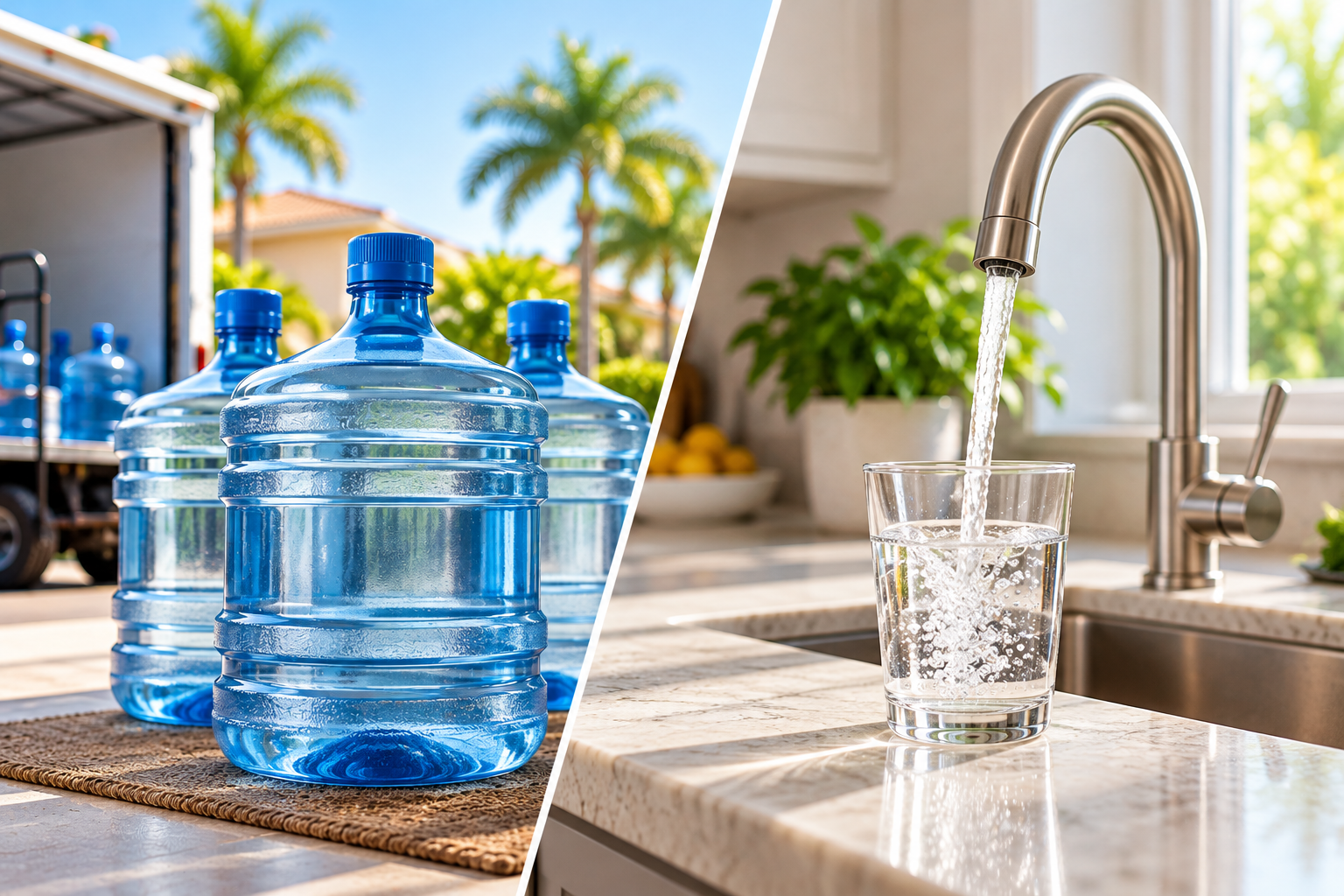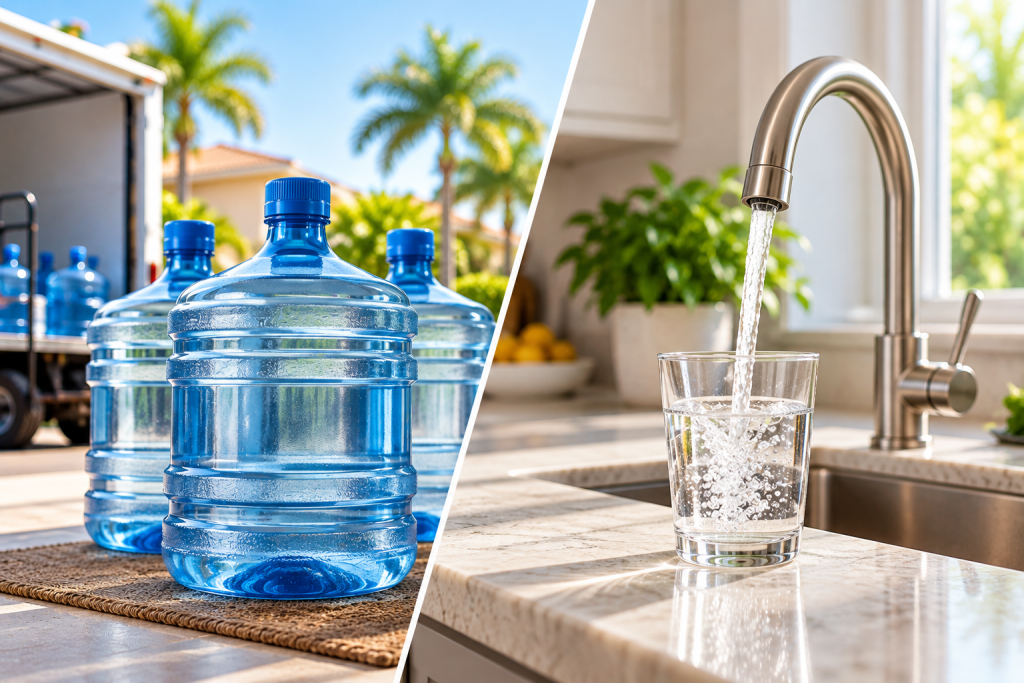
Bottled water delivery is a convenient option for families who only want a separate supply of drinking water. Whole-home filtration treats water as it enters the house, providing filtered water to multiple fixtures. For Tampa Bay families concerned about taste, odor, and water quality throughout the home, whole-home filtration may offer broader benefits and better long-term convenience. The right choice depends on your water concerns, household usage, and budget.
When comparing bottled water vs. filtration in Tampa, the biggest difference isn’t necessarily how the water tastes. It’s how much of your household’s water you want to treat.
Bottled water delivery can provide a dependable supply of drinking water without requiring equipment installation. However, it doesn’t change the water coming from your faucets, showers, or washing machine.
Whole-home filtration takes a different approach. Instead of bringing treated water into your home in containers, a filtration system treats incoming water before it reaches household fixtures.
Both approaches have advantages, but understanding the differences in cost, convenience, maintenance, and water quality can help Tampa Bay families make a more informed decision.
Quick Facts: Bottled Water vs. Whole-Home Filtration
Provides water for drinking and cooking but does not treat the water flowing through household plumbing.
Treats water at the point where it enters the home, supplying filtered water to household fixtures.
Bottled water typically involves recurring delivery purchases, while whole-home filtration generally requires a larger initial investment plus ongoing maintenance.
Neither option automatically removes every contaminant. Treatment performance depends on the water source, technology, and specific product.
What’s the Difference Between Bottled Water Delivery and Whole-Home Filtration?
Bottled water delivery supplies a separate source of drinking water, while whole-home filtration treats water entering the household plumbing system.
How Bottled Water Delivery Works
Bottled water delivery services bring packaged water directly to your home. Depending on the provider, this may involve individual bottles, large refillable containers, or a dispenser.
For families who primarily want water for drinking, making coffee, or preparing meals, this can be a practical solution.
However, the rest of the home’s water remains unchanged. Bottled water won’t address chlorine odors in the shower, sediment in bathroom fixtures, or other water concerns throughout the house.
How Whole-Home Filtration Works
Whole-home filtration, also called point-of-entry filtration, treats water near the point where it enters the home.
Depending on the equipment, a system may be designed to reduce sediment, chlorine taste and odor, or other specific substances.
That means the benefits can extend beyond drinking water to activities such as bathing, cleaning, and laundry.
Homeowners exploring residential water treatment options in Tampa can compare systems based on the particular issues they want to address.
Bottled Water vs. Filtration in Tampa: Which Costs Less?
Bottled water delivery generally has a lower upfront commitment, while whole-home filtration requires a larger initial investment that may become more practical over time for households wanting filtered water throughout the home.
However, neither option is automatically cheaper. The comparison depends on how much water your family uses and what treatment you actually need.
The Ongoing Cost of Bottled Water
With bottled water delivery, households may pay for:
- Recurring water purchases
- Delivery fees or service charges
- Dispenser rental or purchase
- Container deposits or replacement fees
- Additional water during periods of higher consumption
These costs may be manageable for a household that drinks relatively little bottled water. For a larger family, however, recurring purchases can add up.
The Cost of Whole-Home Filtration
A whole-home filtration system typically involves an upfront equipment and installation cost.
Additional expenses may include replacement filters, media changes, professional servicing, and other maintenance specified by the manufacturer.
Although the initial investment is higher, homeowners aren’t purchasing individual containers of filtered water every week.
That can make whole-home filtration attractive for families seeking an ongoing solution to water concerns affecting multiple rooms.
Calculate what your household currently spends on delivered water over 12 months. Then compare that amount with the installed cost, expected maintenance expenses, and estimated service life of a filtration system. Remember that bottled delivery and whole-home filtration provide different levels of treatment coverage, so cost alone doesn’t tell the whole story.
Which Option Is More Convenient for Busy Families?
Whole-home filtration generally offers greater day-to-day convenience once installed, while bottled water delivery avoids installation but requires ongoing coordination and container handling.
The Convenience of Water Delivery
Bottled water delivery can eliminate trips to the grocery store for drinking water.
However, households still need to manage deliveries, find storage space, and replace containers as they empty.
Large refillable bottles can also be heavy and awkward to lift, particularly when loading a dispenser.
Families may need to adjust their delivery schedules when guests visit, children are home from school, or household water consumption increases.
The Convenience of Whole-Home Filtration
Whole-home filtration eliminates the need to coordinate deliveries for water treated by the system.
Once installed, water flows through the filtration equipment as part of normal household use.
There’s no need to store multiple water containers or keep track of how many bottles remain.
However, whole-home filtration isn’t maintenance-free. Filters and other components must be serviced or replaced according to manufacturer recommendations.
If you’re considering whole-home filtration, ask about replacement schedules, routine maintenance, and the availability of professional service before purchasing. Understanding these responsibilities helps you compare the system’s long-term convenience with your current delivery arrangement.
Which Is Better for Water Quality?
Neither bottled water nor whole-home filtration is automatically superior in water quality. The answer depends on the substances present in the water and the treatment processes used.
Understanding Bottled Water Quality
Bottled water sold in the United States is regulated by the Food and Drug Administration.
Different brands may use different water sources and treatment methods, including filtration, reverse osmosis, or other processes.
As a result, bottled water quality and mineral content can vary by product.
It’s important not to assume that bottled water is necessarily free of all contaminants or that it is always safer than properly treated municipal tap water.
Understanding Whole-Home Filtration Quality
Whole-home filtration systems are designed for particular water-treatment goals.
For example, one system may focus on sediment reduction, while another uses activated carbon to address chlorine taste and odor.
Some contaminants require specialized technologies or additional treatment stages.
Families concerned about specific substances in drinking water may benefit from a separate point-of-use system, such as reverse osmosis filtration, depending on the system’s verified reduction capabilities.
For any filtration equipment, check independent certifications and product performance data rather than assuming all systems perform the same way.
Does Whole-Home Filtration Make Water Safer?
Whole-home filtration can reduce certain substances when properly designed and maintained, but installation alone does not guarantee safer water.
Public water systems already operate under drinking-water regulations, and additional home treatment should address an identified concern.
For example, a carbon filtration system designed to reduce chlorine taste and odor may improve the sensory qualities of water without necessarily removing dissolved minerals, microorganisms, or every regulated contaminant.
Likewise, a standard water softener reduces hardness minerals but isn’t a substitute for filtration designed to address other water-quality concerns.
Homeowners who notice spotting, scale, or mineral buildup may want to investigate water softening options separately from filtration.
If your water provider issues a boil-water notice or another drinking-water advisory, follow the official instructions. A standard whole-home filter does not automatically make water safe during a contamination event. Likewise, private well owners should use appropriate testing to identify concerns before selecting treatment.
What About the Environmental Impact?
Whole-home filtration may reduce the need for delivered drinking-water containers, but the environmental comparison depends on the type of bottled-water service, filtration equipment, and household consumption.
Bottled Water Delivery and Packaging
Single-use bottled water creates recurring packaging waste and requires repeated transportation.
However, delivery services using large refillable containers may produce less single-use packaging than purchasing individual disposable bottles.
Reusable containers still require transportation, cleaning, and eventual replacement.
Whole-Home Filtration and Waste
Whole-home filtration can reduce a household’s reliance on packaged drinking water when the treated tap water meets its needs.
However, filtration equipment also has environmental impacts, including manufacturing, replacement media, and disposal of used components.
Some treatment technologies, particularly reverse osmosis, produce reject water during operation.
Therefore, the most environmentally responsible choice isn’t always the largest or most complex treatment system.
Choosing appropriately sized equipment that addresses your actual water concerns can help avoid unnecessary resource consumption.
When Does Bottled Water Delivery Make More Sense?
Bottled water delivery may be a good fit when your family only needs a separate drinking-water supply and doesn’t want to install permanent treatment equipment.
It may be worth considering if:
- You rent and cannot make plumbing modifications.
- Your household uses relatively little bottled water.
- You prefer a specific bottled-water product.
- You need a temporary drinking-water arrangement.
- You don’t have significant water-quality concerns throughout the home.
For some families, the simplicity of having drinking water delivered outweighs the recurring expense and storage requirements.
When Is Whole-Home Filtration the Better Choice?
Whole-home filtration is worth considering when water-quality concerns extend beyond drinking and cooking to other fixtures throughout the house.
It may be a better fit if:
- Chlorine taste or odor is noticeable at multiple faucets.
- You want filtered water for bathing and other household uses.
- Your family uses a substantial amount of delivered drinking water.
- You want to reduce reliance on packaged water.
- You prefer an installed treatment system over recurring deliveries.
- You own your home and are comfortable with equipment maintenance.
Still, whole-home filtration is not always necessary. If your only concern is drinking-water taste at the kitchen sink, a smaller point-of-use system may be more practical and cost-effective.
Can You Combine Whole-Home Filtration With Drinking-Water Treatment?
Yes. Some households use whole-home filtration for broader water concerns and a dedicated drinking-water system for more specific treatment goals.
For example, a whole-home carbon filtration system may address chlorine taste and odor throughout the home, while a separately selected reverse osmosis system provides additional treatment at the kitchen sink.
These systems perform different functions and should be selected based on the substances you want to reduce.
This approach can provide more targeted treatment than relying on a single system to address every possible water concern.
However, not every household needs multiple systems. Understanding your water first can help prevent unnecessary purchases.
What Should Tampa Bay Families Consider Before Switching?
Before replacing bottled water delivery with a filtration system, consider your household’s actual water needs and local water source.
Tampa Bay includes communities served by different municipal utilities as well as properties using private wells.
Water characteristics can vary depending on the provider, source, treatment process, and household plumbing.
A family in Tampa may have different water concerns than a household in Brandon, Plant City, or another surrounding community.
Start by identifying your water provider and reviewing available water quality information. If you have a private well or specific concerns that aren’t addressed by the utility report, appropriate water testing can help clarify the next step.
EcoWater Tampa can help homeowners explore whole-home water treatment solutions based on their household needs and treatment goals.
Frequently Asked Questions About Bottled Water vs. Whole-Home Filtration
Is whole-home filtration cheaper than bottled water delivery?
Is filtered tap water better than bottled water?
Does whole-home filtration remove chlorine?
Will whole-home filtration soften hard water?
Is bottled water delivery more environmentally friendly than filtration?
Does every Tampa Bay home need whole-home filtration?
Can I stop buying bottled water after installing whole-home filtration?
Choose the Water Solution That Fits Your Family
Bottled water delivery can be a convenient solution when your main priority is having a separate supply of drinking water. Whole-home filtration offers a different kind of convenience by treating water throughout the house.
For Tampa Bay families, the best decision comes down to what you’re trying to improve.
If you’re only concerned about drinking water, bottled delivery or point-of-use filtration may be enough. If taste, odor, or other water concerns affect multiple fixtures, whole-home filtration may provide greater everyday value.
Rather than choosing based on price or convenience alone, start with your water quality, household usage, and treatment goals.
Ready to explore an alternative to bottled water delivery? EcoWater Tampa can help you compare treatment options and find a solution that makes sense for your home.
CTA: LEARN ABOUT WHOLE-HOME FILTRATION OPTIONS